Back to demo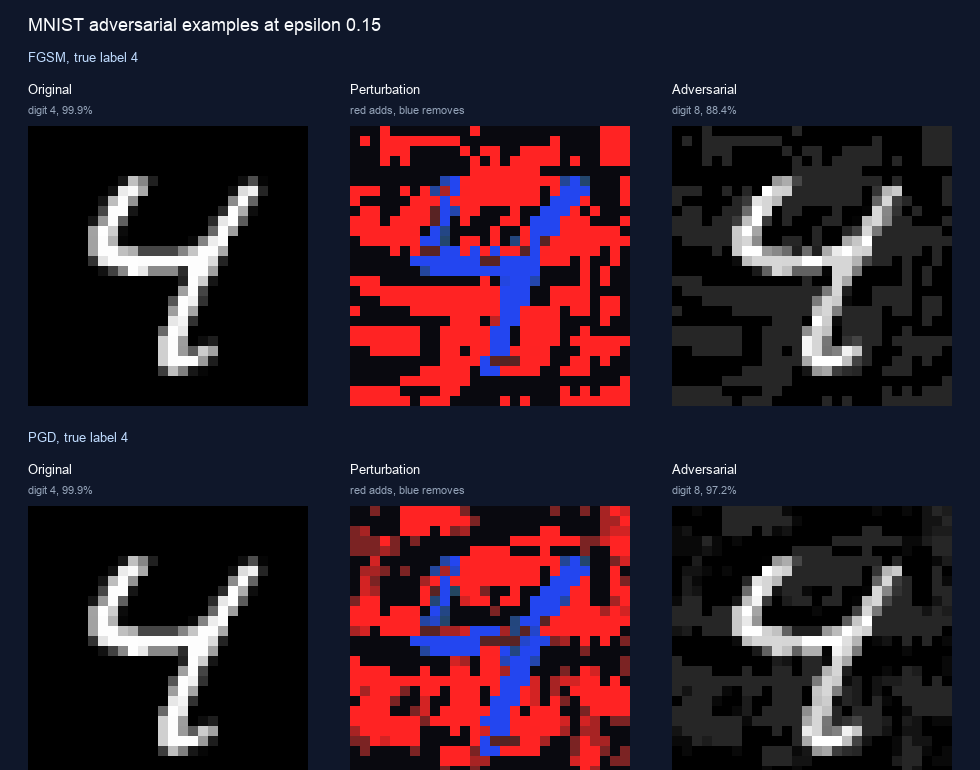
Model details
CNN and attack evaluation
The browser demo runs FGSM interactively. The offline evaluation compares FGSM, PGD, and a random-noise baseline against the same exported model weights.
Clean accuracy
98.54%
Trainable parameters
421,642
Eval samples
2,000
FGSM accuracy by epsilon
97.90.00
94.30.05
86.30.10
68.80.15
47.50.20
24.00.25
9.30.30
Attack
Epsilon
Accuracy
Random noise
0.00
97.90%
Random noise
0.05
97.80%
Random noise
0.10
97.95%
Random noise
0.15
97.80%
Random noise
0.20
97.90%
Random noise
0.25
97.75%
Random noise
0.30
97.55%
FGSM
0.00
97.90%
FGSM
0.05
94.35%
FGSM
0.10
86.25%
FGSM
0.15
68.85%
FGSM
0.20
47.50%
FGSM
0.25
24.00%
FGSM
0.30
9.30%
PGD
0.00
97.90%
PGD
0.05
94.00%
PGD
0.10
79.90%
PGD
0.15
47.25%
PGD
0.20
9.85%
PGD
0.25
0.15%
PGD
0.30
0.00%
PGD uses 10 projected-gradient steps. Random noise is included as a baseline so the adversarial attacks have a non-adversarial comparison.
Raw results are stored in public/attack_results.json and public/attack_results.md.
Saved example
Generated by scripts/evaluate_attacks.py.
Architecture
Input
28 x 28 x 1 grayscale MNIST image
Conv2D
32 filters, 3 x 3 kernel, ReLU, same padding
MaxPool
2 x 2 pooling to 14 x 14 x 32
Conv2D
64 filters, 3 x 3 kernel, ReLU, same padding
MaxPool
2 x 2 pooling to 7 x 7 x 64
Flatten
3,136 features
Dense
128 units, ReLU
Dropout
0.25 during training only
Dense
10 units, softmax
Reproduce the evaluation
python3 scripts/evaluate_attacks.py --limit 2000 --pgd-steps 10
python3 -m pytest -q
- The demo loads weights from public/model_weights.json.
- Selected images are real MNIST test-set samples in public/mnist_samples.json.
- This is a compact educational model, not an adversarially trained or production-grade classifier.